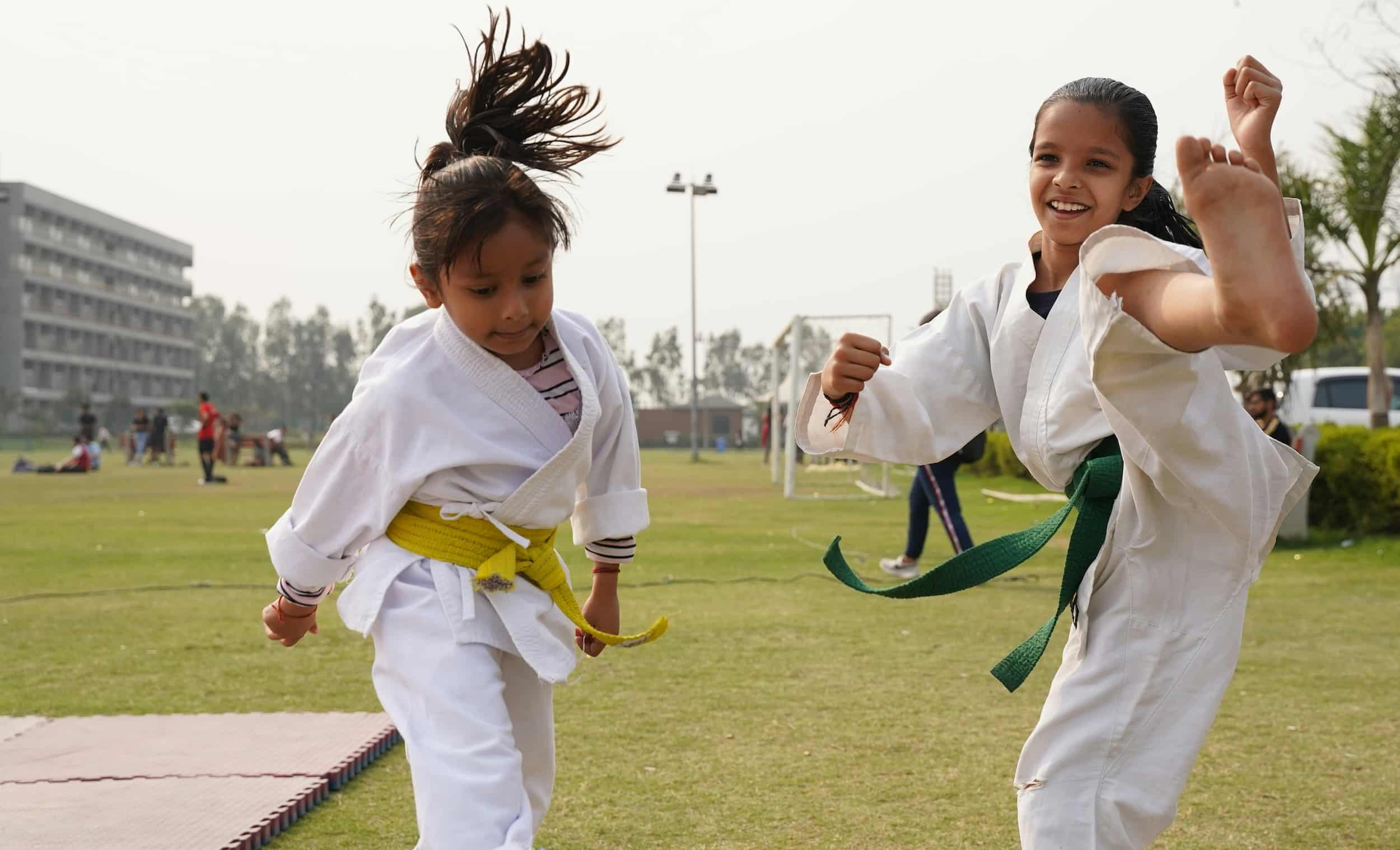

At Silverback Kids Martial Arts, friendship isn’t an accident—it’s built into the way we train. From the moment students bow in, they’re part of a team that practices respect, encouragement, and shared effort. Partner rotations, small-group drills, and age-appropriate challenges make it easy for even shy kids to connect. Coaches model empathy and clear communication, and our kid-first environment (no adult classes) keeps the space safe, welcoming, and focused on positive peer interactions.
Community comes alive at our in-house events. Jungle Jam nights are playful, high-energy evenings where students mix across ages through games, skill stations, and lighthearted challenges—perfect for trying new things and meeting new friends in a relaxed setting. Our in-house tournaments offer a supportive introduction to competition, with an emphasis on sportsmanship, effort, and personal bests. Kids cheer each other on, learn to handle nerves together, and leave with shared memories that deepen bonds. And our birthday parties bring the celebration to the dojo—martial-arts-themed activities, laughter, and teamwork that make your child feel like a star while giving their friends a fun, safe experience.
These experiences reinforce what we practice every day: the TROOP Code—Teamwork, Respect, Ownership, Overcoming Obstacles, and Perseverance. Students learn to listen, take turns, and lift each other up. When conflicts happen, coaches guide kids through simple, respectful resolutions so they can return to training stronger together. As confidence grows, so does kindness; older students naturally support newcomers, and younger students learn to be great teammates.
Parents tell us that the friendships formed here travel beyond the dojo—into school, sports, and daily life. That’s the power of a structured, values-driven community: kids feel seen, they feel safe, and they learn how to be good friends while becoming stronger athletes. Want to plug in? Check the Member Portal for Jungle Jam dates, in-house tournament sign-ups, and birthday party bookings—and join the Silverback community where friendships flourish.
Kids-Only Martial Arts: A Space Where Children Thrive
When children train in a studio designed exclusively for them, everything from the layout to the lesson plans works in their favor. A kids-only martial arts academy isn’t a scaled down adult gym; it’s a purpose built environment that matches children’s attention spans, motor development, and social needs. Age appropriate progressions in Goju Ryu Karate, Brazilian Jiu-Jitsu, and Muay Thai keep classes moving, skills attainable, and confidence growing. Coaches trained specifically to teach kids use short, clear cues and playful structure to turn challenges into wins. Equipment is sized for small hands and growing bodies, and class flow prioritizes safety and momentum so every minute matters.
Safety and safeguarding also improve dramatically in a kids-only setting. With no adult students on the mats, there’s less risk of mismatched partners and more clarity around boundaries. Open sightlines, two-adult supervision, and simple rules, like shoes off, sanitize hands, and wait for a coach invite, create a calm, predictable rhythm that helps children focus. The result is faster skill growth, better behavior, and a learning culture where perseverance and effort are celebrated. Students move with peers at similar stages, enjoy friendly competition, and receive tailored feedback that builds mastery and resilience.
Just as important, the culture belongs to children, and that changes everything. Daily emphasis on leadership and character turns practice into life skills: teamwork, respect, ownership, overcoming obstacles and perseverance (the TROOP code) show up in drill design, partner work, and quick “word of the day” reflections. Parents benefit from this clarity too, with predictable schedules, clean facilities and proactive communication about what to practice at home. In short, a kids-only academy transforms martial arts from a hobby into a pathway for confidence, empathy, resilience, and leadership. Ready to see the difference in one visit? Book A Trial Class and watch your child light up.
Why Our Students Wear the White Gi (Uniform)
Every child begins martial arts as a novice, and the white gi symbolizes that fresh start, a blank canvas ready to be shaped by effort and character. White evokes humility and openness to learning, reminding students that skill is earned one class at a time. Even as belts progress in color, the uniform stays white to reinforce a beginner’s mindset: be curious, respect the process, and grow steadily. It also connects children to a long tradition across Karate and Brazilian Jiu-Jitsu, creating unity on the mats and a sense of belonging to something bigger than themselves.
Just as important, the white gi makes hygiene visible. In a kids-only environment, cleanliness and safety go hand in hand; a bright, clean uniform signals healthy habits and helps reduce the risk of skin issues. Parents and coaches can immediately see whether a gi is fresh, which promotes accountability—“I show up clean, respectful, and ready.” The gi’s fit and simplicity also support safety and learning. Coaches can clearly see body alignment and make quick corrections, helping students move efficiently and avoid preventable injuries. Breathable cotton keeps kids comfortable, and a consistent look across the class minimizes distractions so focus stays on effort and improvement.
Wearing and caring for the white gi is its own lesson in responsibility. Students learn to pack it neatly, wash it after training, and bring it back ready for action, habits that build independence, pride, and resilience beyond the mat. At Silverback, we connect these practices to our TROOP values: Teamwork (uniformity and shared standards), Respect (arriving clean and prepared), Ownership (taking responsibility for readiness and hygiene), Overcoming Obstacles (embracing feedback and correction) and Perseverance (showing up ready, every time). In the end, the white gi isn’t just a uniform; it’s a daily reminder to lead with confidence, empathy, resilience, and leadership. Ready to see your child grow from the inside out? Book A Trial Class and watch them shine.
The Bow in Martial Arts: Respect, Readiness, Tradition
The bow is far more than a greeting—it’s the heartbeat of martial arts culture and a daily reset that helps children arrive with calm focus and a respectful mindset. Rooted in Japanese rei (bow) and reiho (formal etiquette) from Karate and Judo traditions influenced by samurai codes, the bow honors the dojo, the art, and the people we train with; Brazilian Jiu-Jitsu inherited this etiquette from Judo, complementing it with the modern slap-and-fist-bump, while Muay Thai expresses similar respect through the wai and the ceremonial Wai Kru. For kids, this simple act is a powerful ritual: bowing at the doorway says, “I respect this space”; bowing to coaches acknowledges guidance; bowing to partners is a promise of control, care, and consent—“I will keep you safe while we grow together.” It trains readiness, flipping a mental switch from everyday chatter to purposeful practice and it builds gratitude by connecting students to their lineage and team. At Silverback, the bow also reinforces our TROOP code—Teamwork (we learn together), Respect (we honor our space and each other), Ownership (we take responsibility for focus, hygiene, and safety), Overcoming Obstacles (we reset after mistakes and try again) and Perseverance (we show up with effort every class)—and it supports our core values of confidence, empathy, resilience, and leadership by turning courtesy into consistent action. In a kids-only environment, this shared ritual simplifies safety, sets clear boundaries and creates a calm, predictable rhythm that helps children feel secure and coachable. Small gesture, big outcomes: better attention, kinder peer interactions, safer training and a deeper sense of belonging to something meaningful. Want to see the tradition in action and the difference it makes in just one visit? Book A Trial Class and watch your child stand taller from the very first bow.
The Martial Arts Paradox: Training for Peace, Not Violence
At first glance, teaching children precise strikes, takedowns, and escapes while promoting a non-violent philosophy seems contradictory, but it’s exactly this structured training that makes violence less likely. In a kids-only dojo, students practice control before contact: breathe first, set boundaries with calm words, create space, and seek help when needed. Drills teach de-escalation and minimum force responses as a last resort, always with safety rules like tap/stop and clear consent. Tradition reinforces the mindset. In Karate, the bow (rei) and dojo etiquette cultivate respect and humility; in Brazilian Jiu-Jitsu, the emphasis on position, leverage, and controlled exits prioritizes safety over domination; in Muay Thai, the wai and Wai Kru ceremonies honor teachers and lineage, reminding students that strength serves character. These rituals flip a mental switch from everyday chatter to purposeful practice. Paradoxically, confidence reduces conflict: children who feel capable don’t need to posture or “prove” themselves. They become steady under pressure, better at reading situations, and quicker to choose the smarter path—walk away, not escalate. This is where our TROOP code comes alive: Teamwork (we learn together), Respect (we honor space and partners), Ownership (we take responsibility for focus and hygiene), Overcoming Obstacles (we reset and try again), and Perseverance (we show up ready, every time). Layered on top are our core values—confidence, empathy, resilience, and leadership, which turn skills into citizenship. The result is a simple truth: learning how to protect yourself builds the self-control to avoid harm. A clean white gi, a clear bow, and consistent coaching cues create a predictable, kid-centered environment where safety and kindness are the norm. The “paradox” dissolves, martial arts becomes training for peace, not violence, and children carry that calm strength into school, home, and life. Ready to see it in action? Book A Trial Class and watch peace grow with every bow.
The Black Belt: What It Really Means—and Why It’s Black
The black belt is more than a rank; it’s a promise kept to oneself. For kids, it symbolizes years of showing up, listening, practicing with purpose, and treating others with care. A black belt marks mastery of fundamentals and the beginning of deeper learning. It signals leadership and service, the moment a student starts mentoring younger peers, modeling etiquette, and carrying the dojo’s standards into everyday life. In a kids-only environment, that meaning is crystal clear: the black belt is the visible outcome of invisible habits aligned with our core values—confidence, empathy, resilience, and leadership. It’s not just what you can do; it’s who you become while doing it. Why is it black? Modern belt ranks were formalized in Judo by Jigoro Kano in the early 1900s and later adopted across Karate and Brazilian Jiu-Jitsu. Black offered strong contrast against the white gi, making rank easy to recognize, and it withstood daily training. There’s a romantic legend that belts darkened naturally from years of practice; while poetic, we champion the opposite: strict hygiene and a clean uniform every class. Still, the symbolism holds. Black represents depth, maturity, and the ability to “absorb” lessons through thousands of honest reps. It reminds students to move with calm focus and quiet confidence rather than flash. From day one, we set “black belt” as a north star, not pressure, but purpose. We map the journey with belts, stripes, and skill checks so progress feels close, trackable, and exciting. Along the way, TROOP guides behavior: Teamwork and Respect in every partner drill; Ownership for readiness and hygiene; Overcoming Obstacles through feedback and practice; Perseverance when skills feel tough. Step by step, class by class, kids learn that big goals are built from small, consistent choices. That’s the real significance of the black belt: becoming the kind of person who finishes what they start—and lifts others as they climb. Ready to begin the journey? Book A Trial Class and set the compass to black belt.
Why We Train Barefoot: Balance, Safety, and Respect for the Mat
Training barefoot is not just tradition, it is one of the most effective ways for children to learn martial arts with confidence and control. Bare feet give instant feedback from the floor, improving balance and proprioception so kids can feel stance width, pivot angles, and weight shifts in real time. That sensory connection accelerates learning across Karate, Brazilian Jiu Jitsu, and Muay Thai, helping students move with stability, precision, and age appropriate power.
Coaches can also see foot placement clearly and make quick, gentle corrections that prevent bad habits and reduce injury risk. Safety is a major reason we prioritize barefoot training. Shoes can catch or stick on mats, creating unnecessary torque on ankles and knees, while socks can be slippery. Bare feet provide natural grip, support healthy ankle mobility, and keep the class flow smooth and predictable.
It is also a living tradition across martial arts. Bow in, shoes off, focus on the lesson. That simple ritual signals respect for the dojo and for partners from the very first step. Hygiene matters too. In a kids only dojo, clean mats and clean feet are a shared responsibility that reinforces our TROOP values, especially Ownership and Respect. We sanitize mats daily and spot clean between classes. Students arrive with trimmed nails and fresh feet and keep outdoor shoes off the mats at all times. These simple habits protect everyone and model pride in a well kept training space.
While barefoot is our standard, we are committed to inclusion and safety. If your child has a medical or sensory need such as plantar warts, eczema, minor foot injuries, or sensory processing considerations, we will make exceptions and approve specialty grip socks or specialty martial arts shoes. Approved items must have non slip or non marking soles, be worn only on the mats and never outdoors, arrive brand new or freshly cleaned, and be pre approved by our team. Please talk with us before class so we can support your child.
In short, barefoot training builds balance, awareness, and respect, key ingredients in a calm, confident martial artist. Ready to see the difference? Book A Trial Class and watch your child grow stronger, steadier, and more confident, one grounded step at a time.
Why Our Coaches Wear Black Gis
Our coaches wear black gis for reasons that blend tradition, clarity, and practical excellence, all in service of a great experience for children and parents. On the mat, color communicates roles instantly. In a room of students in white, a coach in black is easy to spot from anywhere, which helps kids know exactly who to follow and gives parents immediate clarity about who is responsible for safety and instruction. That quick recognition supports faster class transitions, smoother line ups, and confident responses when a child needs help.
Black also signals seniority and responsibility across many martial arts traditions. It connects to the idea that higher ranks carry the duty to teach, protect, and model the standards of the dojo. We emphasize that this is not about ego. It is about service. A coach in black represents calm leadership, consistent etiquette, and a steady presence that keeps the focus on students.
Practically, black looks professional and cohesive with our brand while standing up well to the movement and contact of daily coaching. Even so, cleanliness is non-negotiable. Just like our student uniforms, coach uniforms must be freshly laundered, well fitted, and in good repair. A clean gi is a visible promise of respect for partners, for the facility, and for the craft. Black can also enhance learning. When coaches demonstrate grips, footwork, and angles, the contrast against a white partner gi helps students see key details more clearly. That means better comprehension and safer practice.
Most importantly, the black gi embodies the habits we teach every day. Show up prepared. Lead with care. Take ownership of readiness and hygiene. Live the TROOP code through teamwork, respect, ownership, overcoming obstacles, and perseverance. When children see coaches wear black with humility and purpose, they see what leadership looks like and what their own journey is guiding them toward.
Ready to see our coaching in action? Book A Trial Class and let your child experience an intro session led by our highly qualified and caring coaches.
Join us for our open house!
You can come join us in March for our Open House! Stop by and see what our academy has to offer your child. Become one of our founding families, the first 100 students to sign up receive a free gear package worth $250!


